
The Affiliate Hustle · Affiliate Networks · Web Hosting
If you are running content websites, affiliate review blogs, or WooCommerce stores, slow server response times directly hurt your Google rankings and conversion rates. Both Hostinger and Cloudways deliver strong speed and reliability, but they operate on completely opposite pricing and infrastructure models. Hostinger is the budget shared-and-cloud host that bundles a free domain, free SSL, and free email into a cheap multi-year deal. Cloudways is a managed cloud platform that puts your sites on dedicated DigitalOcean, AWS, or Google Cloud servers with flat monthly billing and zero renewal hikes. This Hostinger vs Cloudways comparison checks real renewal pricing, LiteSpeed vs Redis caching, and traffic-spike scaling — and gives you a clear winner for each kind of affiliate site.
Disclosure: This comparison contains no affiliate links. The Hostinger and Cloudways links in this article are plain links to the vendors’ official sites — we earn no commission from either one. Our verdict is independent: the scores below are our own assessment, and we reported the downsides of both tools alongside the strengths. Prices change — confirm current pricing on the vendor’s site before you buy.
Quick Verdict
4.7/5
Hostinger
★★★★★
Winner — Most Sites
4.6/5
Cloudways
★★★★★
Winner — High Traffic
Hostinger wins for most affiliate sites. Cloudways wins once traffic demands dedicated cloud power.
Choose Hostinger if you are launching new niche sites or managing a handful of blogs: the lowest upfront cost, a bundled free domain and email accounts, a beginner-friendly control panel, and zero server management.
Choose Cloudways if you have outgrown shared hosting and run high-traffic affiliate sites or heavy stores: true managed cloud infrastructure (DigitalOcean, AWS, Google Cloud) with pay-as-you-go monthly billing and zero renewal price spikes.
Our scores are our own assessment, based on the pricing and features we verified on the vendors’ own sites on November 17, 2026.
$1.99/mo
Hostinger Premium intro price
$11/mo
Cloudways Micro entry price
$10.99/mo
Hostinger Premium renewal price
5 days
Cloudways free trial, no card
01Comparison table: Hostinger vs Cloudways
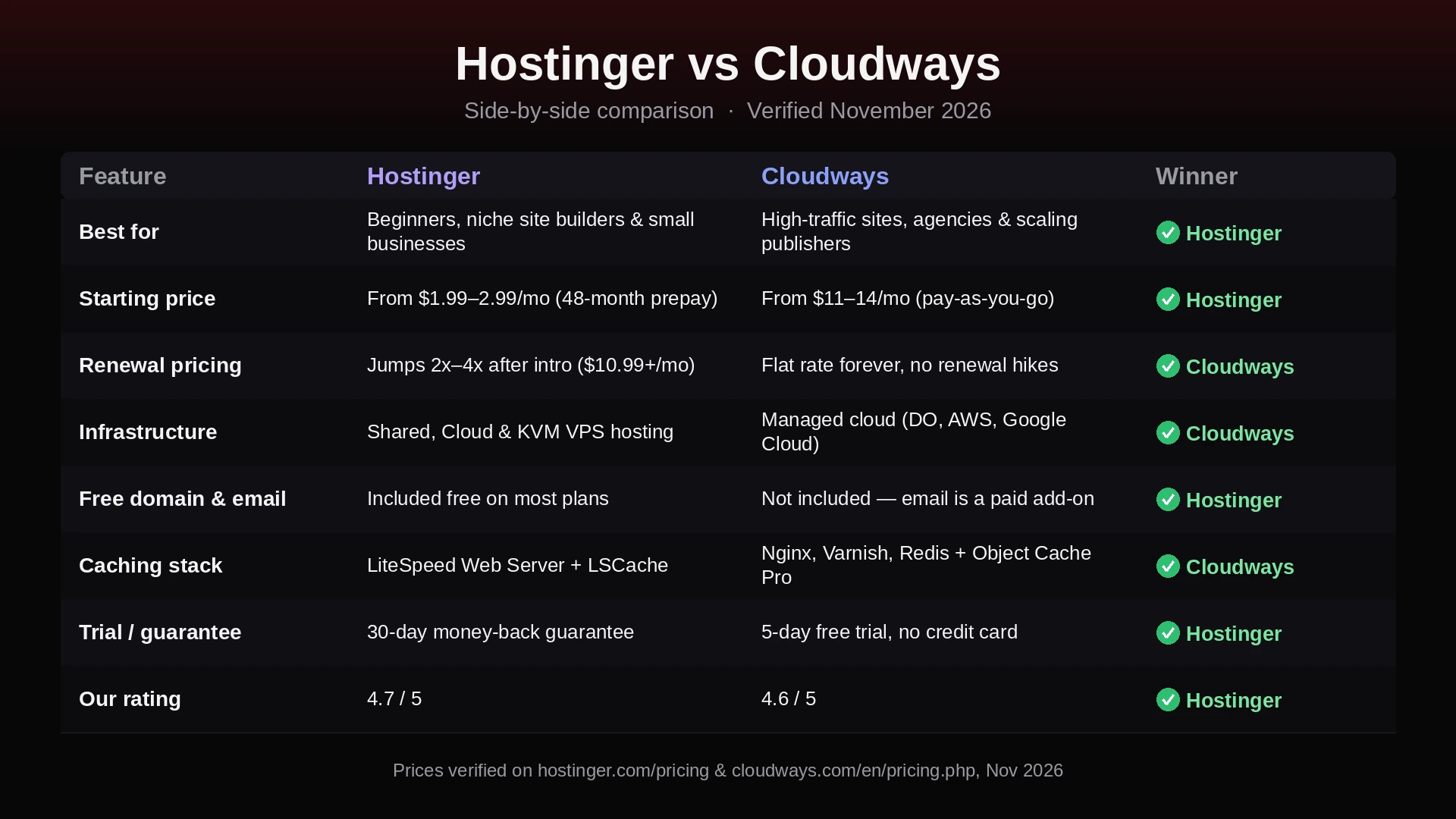
The table below is the whole comparison in one place. Hostinger takes the value, bundling, and refund-window rows. Cloudways takes the infrastructure, renewal-transparency, and caching rows. The 0.1-point gap in the final score is a gap in fit, not quality — read the deep dives below to see which side of that gap your sites sit on.
| Feature | Hostinger | Cloudways | Winner |
|---|---|---|---|
| Best for | Beginners, niche site builders & small businesses | High-traffic sites, agencies & scaling publishers | Hostinger |
| Starting price | From $1.99/mo (Premium) to $2.79/mo (Unlimited) on a 48-month prepay | From $11–14/mo (pay-as-you-go monthly) | Hostinger |
| Renewal pricing | Jumps 2x–4x after the intro term ($10.99+/mo) | Flat rate forever — no renewal hikes | Cloudways |
| Infrastructure | Shared, Cloud & KVM VPS hosting | Managed cloud (DigitalOcean, AWS, Google Cloud) | Cloudways |
| Free domain & email | Included free on most plans | Not included — email is a paid add-on | Hostinger |
| Caching stack | LiteSpeed Web Server + LSCache | Nginx, Apache, Varnish Cache Pro & Redis + Object Cache Pro | Cloudways |
| Trial / guarantee | 30-day money-back guarantee | 5-day free trial, no credit card required | Hostinger |
| Our rating | 4.7/5 | 4.6/5 | Hostinger |
If you already know which camp you fall into, the short version is simple: lean affiliates who want the lowest overhead should start with Hostinger, and established publishers running high-traffic sites should look hard at Cloudways. The rest of this article is for everyone who wants to know why — and exactly what each host costs, where its limits actually sit, and where each one falls short.
024 core differences at a glance
1. Upfront promo pricing vs. flat monthly billing
Hostinger has the lowest entry price in this comparison — often under $3 a month — but only when you prepay for 48 months upfront. When that intro term ends, renewals jump 2x–4x: the Premium plan goes from $1.99 a month to $10.99 a month. Cloudways charges monthly (or hourly), with no multi-year commitment, and the rate never spikes at renewal. The trade is simple: Hostinger is cheaper today if you can commit for four years; Cloudways is cheaper over five years if you count what you actually pay once the intro deal is gone.
2. Bundled extras vs. pure server power
Hostinger bundles the extras: a free domain for the first year, free SSL, and free email mailboxes on most plans. Cloudways bundles none of that — no domains, and business email costs extra per mailbox. Every dollar on Cloudways goes to server compute, RAM, and caching instead. If you are launching a site and want everything in one invoice, Hostinger’s bundle wins. If you already own your domains and just need raw server power, Cloudways gives you more of it per dollar.
3. Traffic spike handling & vertical scaling
Shared hosting can slow down — or hit CPU limits — when a post goes viral or a sale spikes traffic. Cloudways scales RAM and CPU with a few clicks on DigitalOcean, Vultr, AWS, or Google Cloud, so a traffic surge is a settings change, not a migration. Hostinger’s Cloud Startup tier adds dedicated CPU cores and 4 GB of RAM, which covers moderate spikes, but it is still a fixed box: when you outgrow it, you move plans. For a site that lives or dies by sudden traffic, the ability to scale vertically in minutes is Cloudways’ strongest card.
4. Control panel usability
Hostinger runs on hPanel, its own beginner-friendly control panel, with the Kodee AI assistant built in — domain, email, files, and backups in one place, and nothing that looks like a server. Cloudways runs a server-and-application dashboard with granular controls over PHP workers, Varnish, and firewalls. It is more technical, and that is the point: it gives you the levers a growing site needs. Beginners will be faster on hPanel; anyone who has ever tuned a cache or chased a slow query will feel at home on Cloudways.
03Hostinger in depth
Hostinger is a high-value web host engineered to make launching fast WordPress websites affordable and simple for solo creators and growing businesses. Its whole pitch is one invoice, one panel, and a price that looks almost too low — and for the first four years, it is.
Hostinger strengths
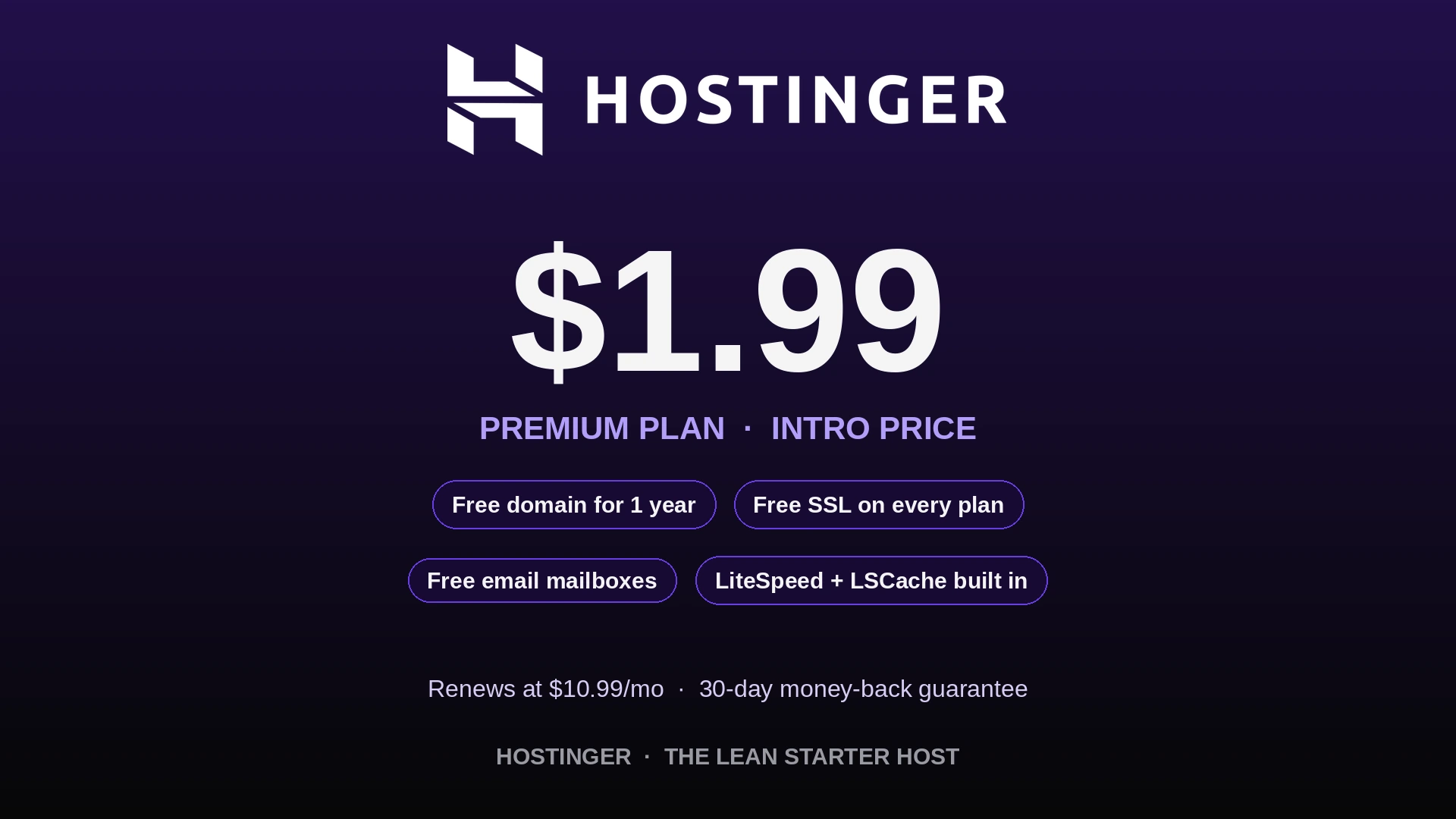
- 4-year entry value: Premium from $1.99 a month and Unlimited from $2.79 a month on a 48-month prepay — the cheapest way into a real host in this comparison.
- LiteSpeed architecture: LiteSpeed Web Server with server-level LSCache, which is genuinely fast WordPress hosting out of the box with no plugins to configure.
- All-in-one convenience: domains, email, staging, and daily/weekly backups in one panel — one login, one invoice.
- Cloud Startup tier: dedicated CPU cores, 4 GB of RAM, and 100 GB of NVMe storage from $7.99 a month intro ($25.99 renewal) for sites that have outgrown shared limits.
Where Hostinger falls short
- Steep renewal hikes: the advertised rates require a 48-month prepay, and renewal invoices jump in year five — Premium goes from $1.99 to $10.99 a month.
- Monthly billing kills the discount: pay month to month and the deep discount disappears — at that point it costs more than Cloudways’ flat monthly rate for comparable resources.
- Shared limits on the cheap tiers: the entry plans are shared hosting, so a viral spike can still hit CPU limits before you upgrade to Cloud Startup.
Ideal for: affiliate marketers, bloggers, and beginners launching 1–10 content websites — anyone who wants the lowest possible upfront cost and a panel that never shows them a server.
04Cloudways in depth
Cloudways is a managed cloud hosting platform that bridges the gap between raw cloud servers (like DigitalOcean and AWS) and user-friendly WordPress management. You pick the cloud, the data center, and the server size; Cloudways manages the server, the stack, and the caching — and bills you a flat monthly rate that never jumps at renewal. That is the core of this managed cloud hosting comparison: one host sells you a bundle, the other sells you a server.

Cloudways strengths
- Dedicated cloud resources: guaranteed RAM and vCPU on your own cloud server — no shared neighbors, no noisy-neighbor slowdowns.
- Enterprise caching: Nginx, Varnish, Memcached, and Redis, plus Object Cache Pro free on 4GB+ servers (normally $95 a month) — a serious speed stack for WordPress and WooCommerce.
- Predictable monthly billing: flat rates, zero contracts, and zero renewal jumps. The price you sign up at is the price you keep paying.
- Unlimited websites per server: host as many apps as your server can handle, with free staging environments and free SSL on every app.
Where Cloudways falls short
- Add-on costs: offsite backups, extra storage, and email are billed separately — the headline server price is not the whole invoice.
- Short free trial: the Flexible free trial is 5 days, not a 30-day refund window — enough to test a deployment, not enough to run a full month of traffic through it.
- No bundled domain or email: you bring your own domain and pay extra for business email, which adds friction for a first site.
Ideal for: established affiliate publishers, agencies, and high-traffic sites — anyone whose sites already earn and need dedicated resources that scale without a migration.
05Pricing comparison
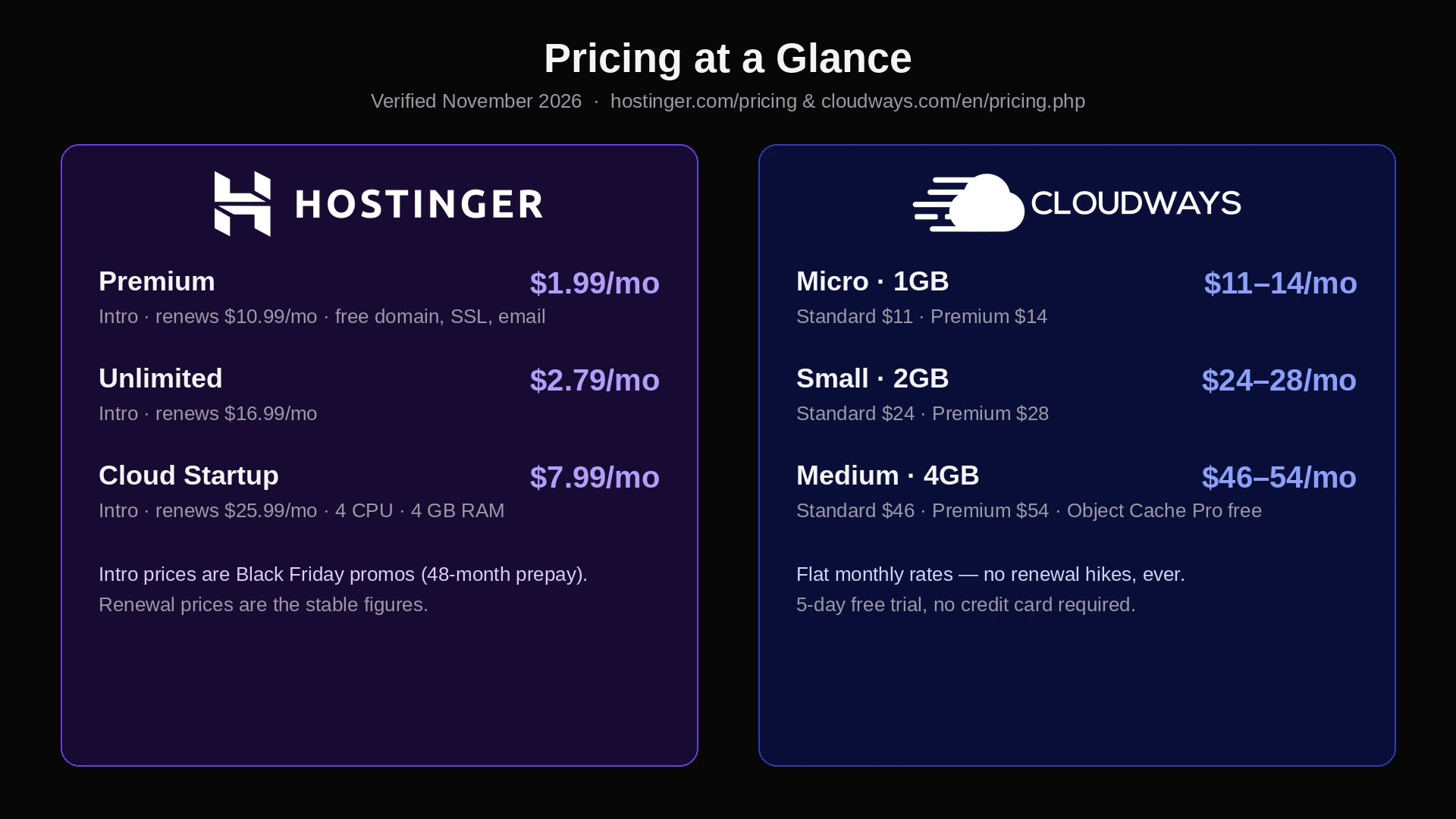
Here is the Hostinger renewal pricing vs Cloudways breakdown — what each host actually charges, checked against the vendors’ own pricing pages on November 17, 2026. Hostinger’s intro prices are Black Friday promo prices for a 48-month prepay — the renewal column is the stable figure you will actually pay from year five on. Cloudways’ prices are flat monthly rates with no renewal hike, ever.
Hostinger pricing tiers
| Plan | Intro price | Renews at | What you get |
|---|---|---|---|
| Premium | $1.99/mo | $10.99/mo | Free domain, free SSL, free email mailboxes |
| Unlimited | $2.79/mo | $16.99/mo | Everything in Premium, more sites and resources |
| Cloud Startup | $7.99/mo | $25.99/mo | 4 CPU cores, 4 GB RAM, 100 GB NVMe storage |
All Hostinger plans are paid upfront; the monthly rate is the total divided by the months. Prices exclude VAT. Every plan carries a 30-day money-back guarantee.
Cloudways pricing tiers (DigitalOcean, Flexible)
| Server | Standard | Premium | What you get |
|---|---|---|---|
| Micro · 1GB RAM | $11/mo | $14/mo | 1 vCPU, 25 GB NVMe, 1 TB transfer |
| Small · 2GB RAM | $24/mo | $28/mo | 1 vCPU, 50 GB NVMe, 2 TB transfer |
| Medium · 4GB RAM | $46/mo | $54/mo | 2 vCPU, 80 GB NVMe, 4 TB transfer, Object Cache Pro free |
| Large · 8GB RAM | $88/mo | $99/mo | 4 vCPU, 160 GB NVMe, 5 TB transfer, Object Cache Pro free |
Cloudways bills monthly with no contracts and no renewal hikes — the rate you sign up at is the rate you keep. The 5-day free trial needs no credit card and covers DigitalOcean, Vultr, and Linode servers (it excludes AWS and Google Cloud). Object Cache Pro is free on 4GB+ servers; it normally costs $95 a month.
Black Friday note, checked November 17, 2026: both hosts were running Black Friday promos when we verified prices. Hostinger’s intro prices above are its Black Friday promo prices (85% off Premium and Unlimited). Cloudways was offering 80% off the first 2 months with code BFCM802, ending December 4, 2026. Promo prices change — the renewal and flat-rate figures in the tables above are the ones that matter long term.
The renewal trap, in numbers
Four years of Hostinger Premium at the intro rate costs $95.52. Year five renews at $10.99 a month — $131.88 a year. Four years of Cloudways Micro at the Standard rate costs $528. Hostinger is cheaper for the first four years by a wide margin; Cloudways is cheaper from year five on, and it never asks you to prepay four years to get its best price. If your sites will still be running in five years, do the math on the renewal column, not the intro column.
06Who should use which?
The choice comes down to where your websites are in their growth lifecycle. If you are shopping for the best hosting for affiliate websites 2026, the answer depends on that lifecycle, not on the headline price. Neither host is wrong — they are built for different stages of the same business.
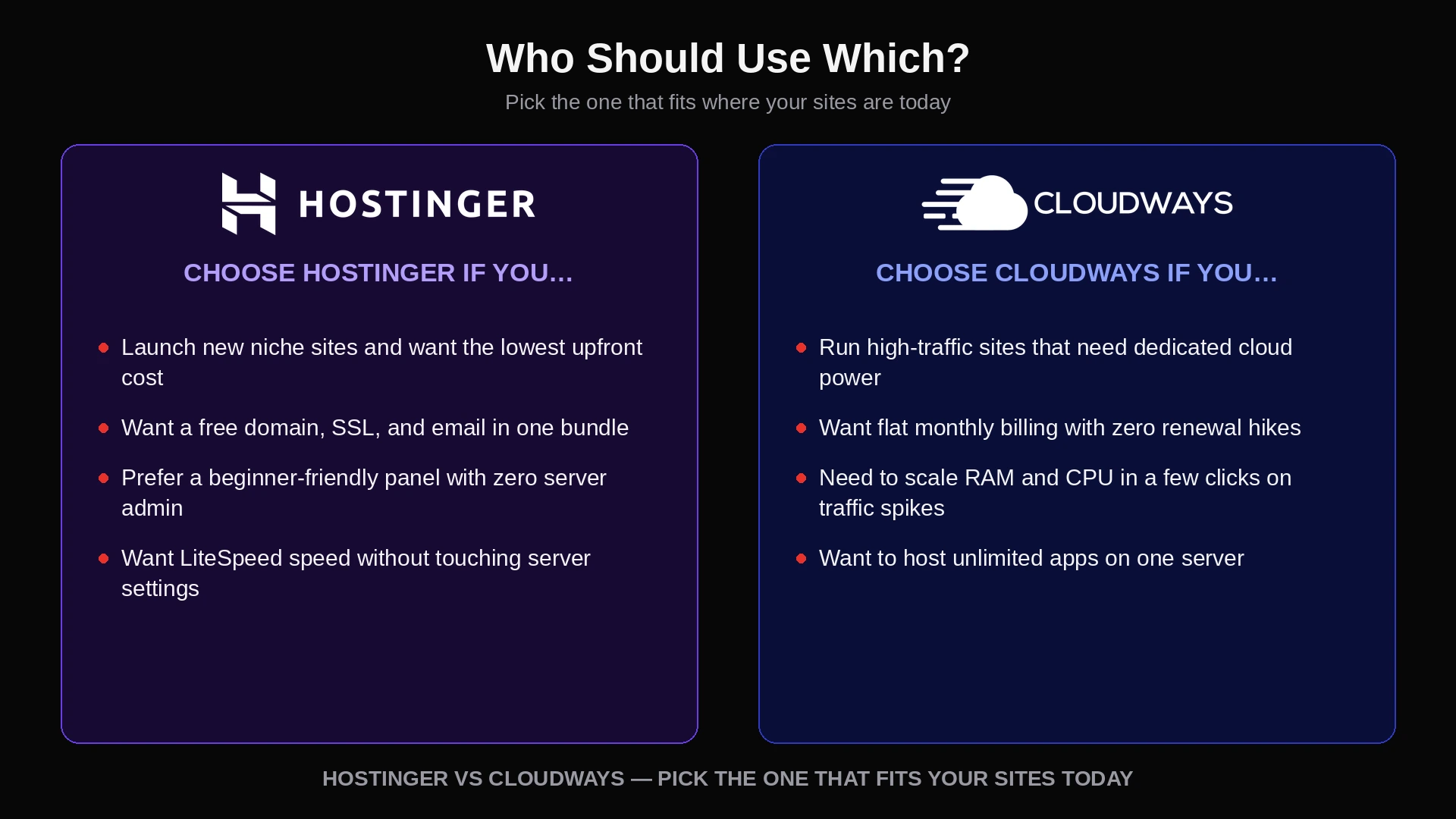
Choose Hostinger if you…
- Are building new affiliate websites or growing small-to-medium blogs.
- Want the lowest possible upfront cost and a free domain and email bundle.
- Prefer a beginner-friendly panel with zero server management.
- Want LiteSpeed speed without touching server settings.
Choose Cloudways if you…
- Run high-traffic affiliate sites or heavy WooCommerce stores.
- Want flat monthly billing with zero renewal hikes.
- Need dedicated resources and one-click vertical scaling on traffic spikes.
- Want to host unlimited apps on one server.
The honest middle path: start on Hostinger while your sites are new and your budget is tight, and move to Cloudways when a site is earning enough that a traffic spike — or a renewal invoice — would cost you more than the move. The exact traffic milestone is different for every site, but the signal is the same: when shared limits start showing up in your load times, it is time.
07Final verdict: Hostinger vs Cloudways
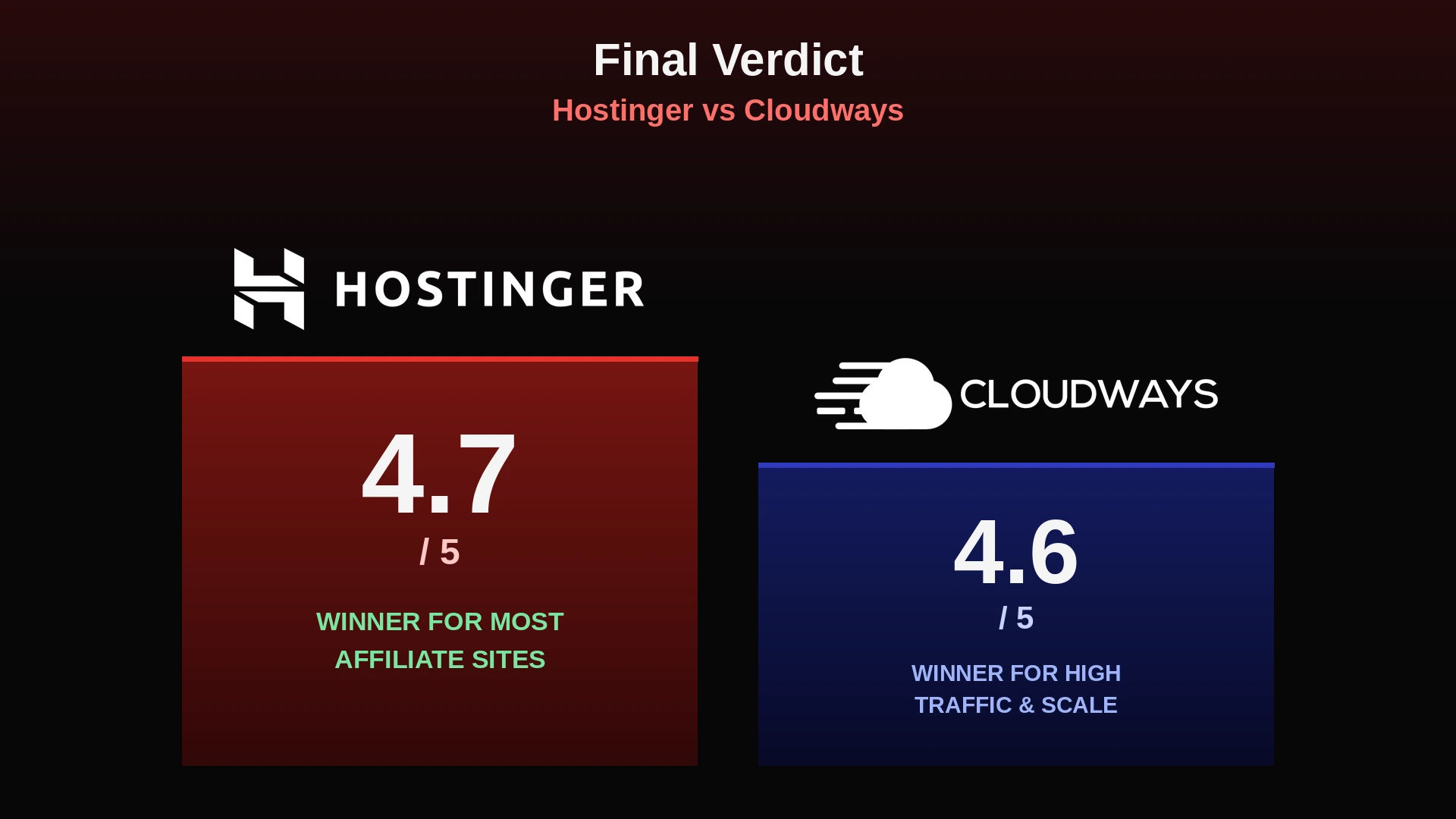
In this Hostinger vs Cloudways final verdict, Hostinger wins for most affiliate sites, and the reasons stack up in the same direction. It is built for the thing most affiliates actually do — launch niche sites fast, keep overhead near zero, and get a domain, SSL, and email in one invoice. Its Premium plan from $1.99 a month intro (renews $10.99) is the cheapest honest way into a fast WordPress host, and its LiteSpeed caching means your pages are quick without plugins to configure. Our score is Hostinger 4.7 out of 5: the host that keeps a lean affiliate profitable from day one.
Cloudways wins for high traffic and scale, and that win is just as clear. Its dedicated RAM and vCPU, enterprise caching stack, and one-click vertical scaling are built for sites that already earn — and its flat monthly billing means the price you sign up at is the price you keep, with no renewal invoice waiting in year five. If your sites already generate steady traffic and revenue, Cloudways is worth every dollar of its $11-a-month entry price, and our score of Cloudways 4.6 out of 5 reflects a genuinely excellent platform that simply costs more and asks more of its user to set up. The 0.1-point gap is not a gap in quality — it is a gap in fit. Cloudways is a better host for a smaller group of publishers; Hostinger is the better host for almost everyone else.
So the recommendation is simple. If you are building new affiliate websites or growing small-to-medium blogs — or you want the lowest upfront cost with a free domain and email in the bundle — start with Hostinger: Premium from $1.99 a month, with a 30-day money-back guarantee behind it. If your site is already generating steady traffic and revenue, go to Cloudways and buy the dedicated resources your traffic needs — and use the 5-day free trial to prove the lift before you commit. Either way, stop guessing: the host you choose is the difference between a site that loads fast and converts, and a site that costs you rankings every time it slows down.
Our pick for most affiliates: Hostinger
Premium from $1.99 a month intro (renews $10.99). Free domain, free SSL, and free email in the bundle. 30-day money-back guarantee. Our score: 4.7/5.
Get Up to 85% Off Hostinger PlansRunning high-traffic sites instead? Cloudways is the right call for you — 5-day free trial at cloudways.com.
Ready to pick a host?
If you have read this far, you already know the cost of picking the wrong host — renewal invoices that triple your bill, shared limits that slow your pages on the days that matter most, and a migration you did not plan for. The fix is a host that fits where your sites are today: Hostinger if you want the lowest overhead, Cloudways if you run high-traffic sites that need dedicated cloud power. Hostinger has a 30-day money-back guarantee, Cloudways has a 5-day free trial, so the cheapest way to decide is to try the one that matches your sites and see it on your own traffic before you pay anything.
Start today
Hostinger Premium from $1.99 a month intro. Cloudways Micro from $11 a month with a 5-day free trial. Pick the one that fits how you earn, and build from there.
Get Up to 85% Off Hostinger Plans Launch Your Free 5-Day Cloudways TrialWant to compare more tools before you decide? Read our GoHighLevel vs ClickFunnels comparison, our Scale.gg review, and how to promote ClickBank products without a website — your hosting choice is the foundation those strategies run on.
Sources
- Hostinger.com — shared, cloud & VPS hosting plans, domain & email bundles, LiteSpeed caching, 30-day money-back guarantee.
- Hostinger Pricing — Premium $1.99/mo intro (renews $10.99/mo), Unlimited $2.79/mo intro (renews $16.99/mo), Cloud Startup $7.99/mo intro (renews $25.99/mo).
- Cloudways.com — managed cloud hosting, DigitalOcean / AWS / Google Cloud servers, Varnish & Redis caching, Object Cache Pro, 5-day free trial.
- Cloudways Pricing — Micro 1GB $11–14/mo, Small 2GB $24–28/mo, Medium 4GB $46–54/mo, Large 8GB $88–99/mo; flat monthly rates with no renewal hikes.
- Cloudways Pricing And Hosting (2026): Plans, Trial & Speed — our full breakdown of Cloudways plans, the 5-day free trial, and the 5-day free trial terms.
More From The Affiliate Hustle
- Cloudways Pricing And Hosting (2026): Plans, Trial & Speed
- Hostinger vs SiteGround (2026): Which Hosting Wins for Affiliate Sites?
- Best WordPress Hosting For Affiliate Sites (2026): 5 Hosts Tested
- Elementor Hosting vs Hostinger (2026): Which Is Better For WordPress?
- IONOS WordPress Hosting Review (2026): Best Budget Host For Bloggers?
- WHMCS vs Blesta (2026): The Best Billing Software For Web Hosts
- Bluehost vs HostGator (2026): Which Is Better For WordPress?
- Best Hosting For Affiliate Marketing (2026): 7 Hosts Compared
- How To Make Money With Hostinger Affiliate Program (2026)
- Cloudways Affiliate Program Review (2026): $125 Per Sale?
- ClickFunnels vs WordPress (2026): Which Is Better For Affiliates?
- Best Affiliate Programs For Beginners (2026): 15 Networks That Pay
- Best Affiliate Networks For Beginners (2026): 10 Networks That Pay Fast
- Affiliate Marketing For Beginners (2026): How To Start & Earn
- Affiliate Marketing Examples (2026): 11 Real Campaigns That Work
- ClickBank Affiliate Marketing (2026): How To Make Money
- Amazon Associates vs ClickBank (2026): Which Pays More?
- GoHighLevel vs ClickFunnels (2026): Which Is Better?
- Leadpages vs ClickFunnels (2026): Which Is Better For Sales?
- ClickFunnels Affiliate Program Review (2026): 40% Recurring?
- Scale.gg Review (2026): Is This Legit Or A Scam?
- Scale.gg Affiliate Program Review (2026): $100 Per Referral?
- 13 Affiliate Marketing Mistakes To Avoid (2026)
- Best VPN Affiliate Programs (2026): 10 Networks That Pay
- Online Casino Affiliate Programs (2026): The 12 Best
- Elementor Affiliate Program Review (2026): 50% Commission?
- DigitalOcean vs AWS (2026): Which Cloud Is Better?
- How To Make Money With WordPress Plugins (2026)
- Best AI Tools For Affiliate Marketing (2026): 12 Tools Tested
- Affiliate Disclosure Examples (2026): 7 Templates That Work
- How To Build A Niche Website (2026): Step-By-Step
- How To Promote Affiliate Links (2026): 9 Methods That Work
- Affiliate Marketing vs Dropshipping (2026): Which Is Better?
- ClickBank Alternatives (2026): 7 Networks That Pay More
- Best Web Hosting For Small Business (2026): 5 Hosts Tested
- How To Make Money Online (2026): 11 Real Methods
- AI Affiliate Marketing (2026): 11 Tools To Automate
- Best Email Marketing Software (2026): 9 Tools Compared
- Most Profitable Affiliate Marketing Niches (2026): 10 Niches
- Hostinger Affiliate Program Review (2026): 40% Commission?
- How To Become An Affiliate Marketer (2026)
- Best Free Affiliate Marketing Courses (2026): 9 Courses
- Best Affiliate Programs In Nigeria (2026): 10 Networks
- Affiliate Marketing In Nigeria (2026): How To Start
- Best AI Writing Tools (2026): 9 Tools For Bloggers
- Best Affiliate Programs (2026): 20+ Networks Compared
- Contact The Affiliate Hustle






Leave a Reply